
Research and Education
Dihexa Peptide — Nootropic Research Guide | Zybiopeps
The Peptide That Made Neuroscientists Stop and Pay Attention
Dihexa capsules have earned a reputation in nootropic research circles that most compounds never achieve — and the science behind that reputation is worth understanding properly. When a team at Washington State University published findings suggesting that Dihexa was roughly ten million times more potent than BDNF at promoting hippocampal synaptogenesis, that was not the kind of number you gloss over. Brain-derived neurotrophic factor is arguably the most studied growth factor in neuroscience. The idea that a synthetic peptide could outperform it by seven orders of magnitude in a specific laboratory context turned a lot of heads and redirected serious research attention toward this compound.
The compound originated from work on the renin-angiotensin system, specifically from angiotensin IV, a peptide fragment that had been studied for its role in blood pressure and kidney function. What the WSU team found was that certain analogs of angiotensin IV had dramatic effects on cognitive function in animal models — effects that pointed not to neurotransmitter tweaking but to something structurally deeper. That discovery is what separates Dihexa from the crowded field of nootropic compounds that cycle in and out of research interest every few years.
Synaptogenesis — Why It Matters More Than You Might Think
Most people in the nootropic space talk about memory and focus. What rarely gets discussed is the mechanism underneath those outcomes — the actual formation of new synaptic connections between neurons. Synaptogenesis is that process, and it is foundational to everything from learning new skills to recovering function after neurological injury. The brain is not static. It rewires itself constantly based on experience, and the density and quality of synaptic connections in the hippocampus is directly tied to how well we encode and retrieve information.
Dihexa promotes this process through the HGF/MET signaling pathway — hepatocyte growth factor and its receptor, MET. This pathway has been implicated in neuronal survival, brain development, and recovery from injury. When Dihexa activates it, the downstream effect in laboratory models is the sprouting of new dendritic spines and the formation of functional synaptic connections. That is a different category of action compared to compounds that simply boost acetylcholine or modulate dopamine. Those approaches work around the existing architecture. Dihexa, at least in research models, appears to change the architecture itself.
For a closer look at the science, this PubMed study examining HGF/MET signaling and synaptic plasticity provides peer-reviewed context for the mechanism researchers are investigating with compounds like Dihexa.
Capsules vs Powder — A Practical Consideration for Researchers
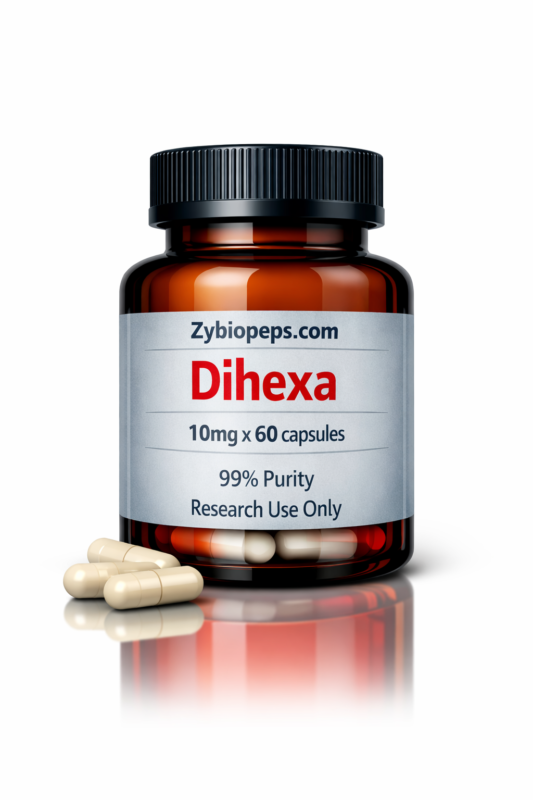
Dihexa is available in both lyophilized powder and capsule form, and the choice between them comes down to the needs of the research protocol. Capsule format offers a stable, pre-measured dose that eliminates the reconstitution step and reduces handling variables. For studies that require consistent oral administration without the preparation time associated with peptide reconstitution, 10mg capsules offer a cleaner workflow. Zybiopeps supplies Dihexa at Zybiopeps in 10mg capsules, 60 per bottle, independently verified by HPLC to a minimum of 99% purity with a Certificate of Analysis available for every batch.
Where Dihexa Research Is Headed
The most active research interest in Dihexa currently sits at the intersection of cognitive aging and neurodegeneration. Alzheimer’s disease, traumatic brain injury, and age-related memory decline all share a common thread — the degradation of synaptic density and the loss of functional neuronal connections over time. Compounds that can stimulate synaptogenesis through pathways like HGF/MET represent a genuinely different therapeutic hypothesis from the amyloid-focused approaches that have dominated Alzheimer’s research for decades. Whether Dihexa will prove useful in those contexts remains an open question, but the early data from laboratory models has been compelling enough to sustain serious research interest.
Sourcing Dihexa for Research
Purity documentation is non-negotiable when sourcing peptides for legitimate research. At Zybiopeps, every bottle ships with a full Certificate of Analysis confirming HPLC-verified purity of 99% or greater. We ship same-day from our US warehouse via USPS and FedEx to researchers across the USA, UK, Australia, Canada, Germany, and the Philippines. A $100 minimum order applies sitewide, and bulk pricing is available for institutions and wholesale buyers through our wholesale research peptides page.
Frequently Asked Questions About Dihexa
What is Dihexa? Dihexa is a synthetic nootropic peptide analog derived from angiotensin IV, studied in laboratory settings for its potent ability to promote synaptogenesis through the HGF/MET signaling pathway.
Why is Dihexa considered so potent? Laboratory research suggested Dihexa may be significantly more potent than BDNF at promoting hippocampal synaptogenesis in certain research models, which drove substantial scientific interest in the compound.
What is the HGF/MET pathway? It is a signaling system involving hepatocyte growth factor and its receptor MET, which plays a role in neuronal survival, brain development, and synaptic plasticity — the pathway through which Dihexa is believed to act.
Is Dihexa approved for human use? No. Dihexa is sold strictly for research and laboratory use only and is not approved for human consumption or clinical application.
What purity is Zybiopeps Dihexa? All Dihexa at Zybiopeps is HPLC-tested to 99%+ purity with a Certificate of Analysis provided for every batch.
How does Zybiopeps ship Dihexa? Same-day from our US warehouse via USPS and FedEx. Worldwide shipping available.
Research Disclaimer
Dihexa is sold for research and laboratory use only. It is not a drug, supplement, or therapeutic agent and is not approved for human consumption. Nothing on this page constitutes medical advice. Zybiopeps makes no claims regarding the therapeutic efficacy of any compound sold on this site. Researchers are responsible for compliance with all applicable laws and regulations in their jurisdiction.
