
Research and Education
GHK-Cu Peptide Benefits — Research Overview
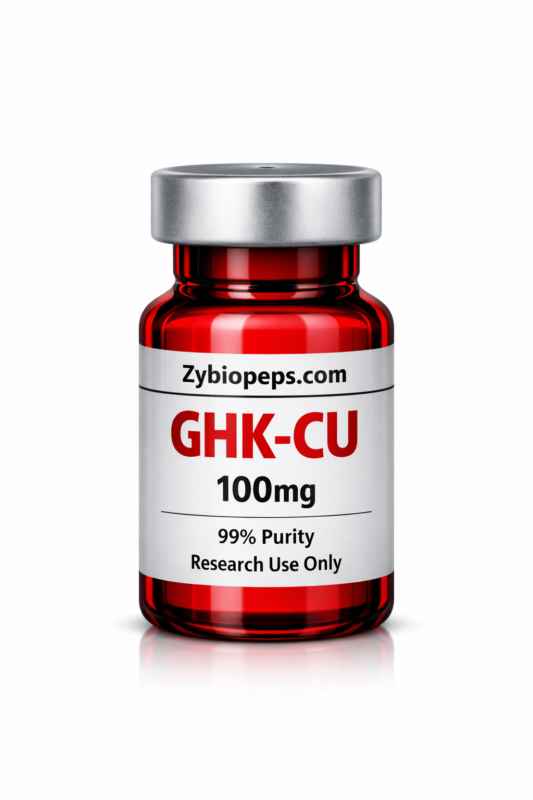
GHK-Cu peptide benefits span an unusually wide range of biological systems — and that’s exactly what makes this compound so fascinating to work with. Most peptides have a lane. This one doesn’t. Wound healing, skin regeneration, nerve repair, hair follicle stimulation, anti-inflammatory activity, antioxidant upregulation, even gene expression regulation. For a three-amino-acid copper complex, the research footprint is extraordinary.
GHK-Cu stands for glycine-histidine-lysine bound to a copper ion. It occurs naturally in human plasma, saliva, and urine — and here’s something researchers find particularly interesting: plasma concentrations drop sharply with age. At 20, levels sit around 200ng/ml. By 60, that’s down to around 80ng/ml. That age-related decline has put this peptide squarely in the crosshairs of longevity researchers, and the volume of published work it’s generated over the past four decades reflects that interest.
At Zybiopeps, this is one of our most requested compounds in the skin and anti-aging research space. We carry it in 50mg and 100mg concentrations — larger quantities than most suppliers stock — because the researchers ordering it tend to be running extended protocols, not one-off experiments.
What the Research Actually Shows
The wound healing data is where GHK-Cu’s research story really begins. Preclinical studies have consistently shown accelerated wound closure, increased collagen and elastin synthesis, stimulated angiogenesis, and reduced oxidative damage in tissue repair models. What’s notable is that these effects aren’t happening through a single pathway — the compound appears to activate multiple repair mechanisms simultaneously, which is unusual and scientifically significant.
The skin biology research is particularly rich. GHK-Cu has been shown to stimulate collagen types I and III, increase glycosaminoglycan synthesis, and modulate the balance between matrix metalloproteinases and their inhibitors. That last point matters — it’s not just cranking up collagen production indiscriminately. It’s creating a more controlled remodelling environment. In aged skin models, one of the more striking findings has been GHK-Cu’s apparent ability to reset gene expression patterns toward a more youthful profile. That’s not a small claim, and it’s backed by peer-reviewed data.
Hair follicle research has added another dimension. Studies in animal models show GHK-Cu increases follicle size, prolongs the anagen growth phase, and upregulates VEGF — vascular endothelial growth factor — around the follicle base. Researchers studying androgenetic alopecia at the cellular level have found it a useful tool precisely because it gives them a way to study follicle biology through multiple mechanisms at once.
The Anti-Inflammatory Angle
Researchers working in inflammation and oxidative stress have found GHK-Cu relevant for different reasons. The compound has shown the ability to reduce pro-inflammatory cytokine production in cell models, inhibit NF-κB signalling, and — interestingly — upregulate the body’s own antioxidant enzyme systems rather than just acting as a direct free radical scavenger. Superoxide dismutase and catalase activity both increase in preclinical models. For researchers studying chronic inflammation and aging, that mechanism is worth paying attention to.
A comprehensive review published on PubMed by Loren Pickart — who first isolated GHK from human plasma back in the 1970s — remains the most thorough overview of the compound’s research profile. If you’re designing a protocol involving this peptide, it’s essential reading.
Sourcing It Right
Here’s the thing with GHK-Cu specifically — because it’s a copper complex, the integrity of that copper binding matters for research validity. A degraded or improperly stored sample isn’t just less effective, it’s a variable you can’t account for. That’s why purity documentation isn’t optional for serious research work.
Every batch we ship at Zybiopeps is third-party HPLC tested to 99%+ purity by an independent USA lab. COA on every order, no exceptions. We ship same day from our USA warehouse via USPS and FedEx — sealed vials inspected before dispatch. Minimum order is $100, and we ship to the USA, UK, Australia, Germany, Philippines, Canada, and worldwide.
Researchers pairing GHK-Cu with other compounds often add our BPC-157 for tissue repair protocols, or Epithalon for broader anti-aging research designs. For labs placing regular multi-compound orders, our wholesale program is worth a look at zybiopeps.com/wholesale-peptides/.
Frequently Asked Questions — GHK-Cu Peptide Benefits
What are the main benefits of GHK-Cu peptide in research?
The research literature documents benefits across wound healing, collagen synthesis, anti-inflammatory pathways, antioxidant enzyme upregulation, nerve regeneration, hair follicle stimulation, and gene expression regulation. It’s one of the most broadly studied naturally occurring peptides available.
Why do GHK-Cu plasma levels decline with age?
The exact mechanism isn’t fully understood, but the decline from approximately 200ng/ml at age 20 to 80ng/ml by age 60 is well documented. This age-related drop is one of the primary reasons longevity researchers have focused on GHK-Cu as a research tool.
Is GHK-Cu the same as copper peptide?
GHK-Cu is the most extensively researched copper peptide in the scientific literature. When researchers refer to copper peptide benefits in a research context, they’re almost always referring specifically to GHK-Cu.
What concentrations of GHK-Cu does Zybiopeps carry?
We stock 50mg and 100mg concentrations, both HPLC tested to 99%+ purity with COA on every batch. Same-day shipping from our USA warehouse, minimum order $100.
Can I order GHK-Cu in bulk?
Yes — our wholesale program is designed for research teams running ongoing protocols. Full details at zybiopeps.com/wholesale-peptides/.
Disclaimer: All products sold by Zybiopeps are intended for research purposes only. They are not approved for human consumption, medical use, or veterinary use. Information provided in this article is for educational purposes and does not constitute medical advice. Researchers are responsible for complying with all applicable local laws and regulations regarding the purchase and use of research compounds.
