
Research and Education
Growth Hormone Peptides: What the Research Shows
Growth hormone peptides research has become one of the most significant areas of modern endocrinology and aging biology — and the volume of scientific interest in this field reflects just how central growth hormone signaling is to human physiology. Growth hormone doesn’t just drive growth during development. It regulates metabolism, body composition, tissue repair, immune function, and a range of processes that become progressively impaired as growth hormone production declines with age. Peptides that interact with growth hormone pathways give researchers powerful tools for studying these mechanisms in controlled preclinical settings.
At Zybiopeps, growth hormone peptides are among our most consistently requested research compounds. We ship same day from our USA warehouse via USPS and FedEx to research teams worldwide — including the USA, UK, Australia, Germany, the Philippines, and Canada. Every compound is third-party HPLC tested to 99%+ purity, packaged in sealed laboratory-grade vials, and comes with a full certificate of analysis. Minimum order starts at just $100, with bulk pricing available through our wholesale program.
What Are Growth Hormone Peptides?
Growth hormone peptides are synthetic compounds that interact with the growth hormone axis — either by stimulating the pituitary gland to produce and release growth hormone, or by activating growth hormone receptors directly. The most studied category is growth hormone releasing peptides, which work through two distinct but complementary mechanisms.
The first mechanism involves GHRH analogues — synthetic versions of growth hormone-releasing hormone, the natural signal that instructs the pituitary to secrete growth hormone. Sermorelin and CJC-1295 are the primary compounds in this category. The second mechanism involves growth hormone secretagogues that work through the ghrelin receptor — a different pathway that also drives growth hormone release. Ipamorelin and GHRP-6 are the most studied compounds in this category.
What makes growth hormone peptide research particularly interesting is that both mechanisms work within the body’s existing regulatory framework — stimulating natural growth hormone production rather than bypassing the pituitary entirely. This preserves the normal feedback mechanisms that prevent excessive growth hormone activity, making these compounds cleaner research tools than direct growth hormone administration.
Growth Hormone Releasing Peptides: The Research Landscape
The growth hormone releasing peptide research landscape has expanded significantly over the past two decades. What started as investigation into basic pituitary physiology has evolved into sophisticated multi-compound research programs studying the intersection of growth hormone biology with aging, metabolic disease, body composition, tissue repair, and cardiovascular function.
Our research team at Zybiopeps has followed this evolution closely. The shift from single-compound GH studies to multi-mechanism research designs — combining GHRH analogues with ghrelin receptor agonists, for example — reflects a more mature understanding of how growth hormone secretion actually works in vivo. Natural growth hormone release involves both GHRH and ghrelin signaling working synergistically, and research designs that replicate this dual stimulation are producing some of the most interesting data in the field.
Sermorelin: The Foundation of GH Peptide Research
Sermorelin is the synthetic analogue of the first 29 amino acids of endogenous GHRH — the biologically active fragment responsible for pituitary stimulation. It’s been studied for longer than any other growth hormone peptide, and its clinical development history gives it a more complete safety and efficacy profile than most research compounds in this category.
Research has documented Sermorelin’s ability to restore more youthful patterns of growth hormone secretion in subjects with age-related GH decline — improving both the frequency and amplitude of GH pulses in ways that more closely mirror young adult secretion patterns. Associated improvements in IGF-1 levels, body composition, bone density markers, and metabolic function have been documented across multiple study designs.
Sermorelin’s relatively short half-life is actually one of its research advantages — it allows for precise timing of GH stimulation in study designs, giving researchers control over the temporal pattern of hormone release. Research-grade Sermorelin is available at Zybiopeps with same day USA shipping and full COA documentation.
CJC-1295: Extended Growth Hormone Stimulation
CJC-1295 addresses the short half-life limitation of native GHRH through a clever chemical modification — it binds to albumin in the bloodstream, dramatically extending its active period from minutes to days. This makes it a fundamentally different research tool from Sermorelin, enabling study designs that examine sustained growth hormone stimulation rather than acute pulsatile responses.
Research has shown CJC-1295 produces sustained elevations in both GH and IGF-1 across extended periods, with associated improvements in body composition, recovery markers, and metabolic function in animal studies. For researchers studying the chronic effects of growth hormone restoration on aging-related outcomes, CJC-1295 offers a more practical tool than shorter-acting analogues.
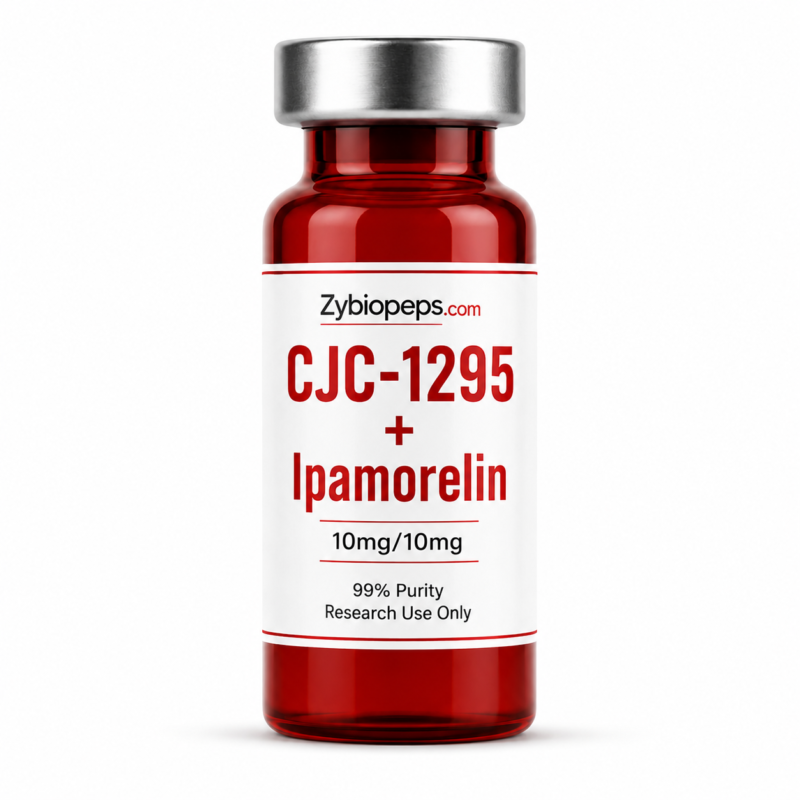
Many researchers study CJC-1295 in combination with Ipamorelin — a pairing that replicates the dual GHRH/ghrelin stimulation of natural GH release. Research-grade CJC-1295 is available at Zybiopeps with full purity documentation.
Ipamorelin: The Cleanest Growth Hormone Secretagogue
Ipamorelin works through a completely different mechanism from the GHRH analogues — it activates the ghrelin receptor to stimulate growth hormone release. What sets it apart from earlier compounds in this class is its remarkable selectivity. Research has consistently shown that Ipamorelin stimulates GH release with minimal effect on cortisol, prolactin, or ACTH — unintended hormonal effects that complicated the use of earlier secretagogues like GHRP-6 in research settings.
This selectivity makes Ipamorelin a significantly cleaner research tool for studying growth hormone biology specifically, without the confounding hormonal effects that make data interpretation more difficult. Studies have documented improvements in bone mineral density, lean muscle preservation, fat metabolism, and recovery markers in research subjects receiving Ipamorelin — all areas of direct relevance to aging and longevity research.
Research-grade Ipamorelin is available at Zybiopeps with 99%+ purity and same day worldwide shipping from our USA warehouse.
Growth Hormone Peptide Therapy Research: What the Studies Show
Growth hormone peptide therapy research has accumulated a substantial body of preclinical and clinical evidence over the past three decades. The consistent findings across this literature include restoration of more youthful GH secretion patterns in aging subjects, improvements in body composition including reduced fat mass and preserved lean muscle, better bone mineral density maintenance, improvements in sleep quality related to GH’s role in slow-wave sleep, and enhanced recovery from physical stress in research models.
What’s particularly compelling about the growth hormone peptide research literature is the consistency of findings across different compounds and different study designs. Whether researchers use GHRH analogues, ghrelin receptor agonists, or combinations of both, the downstream effects of restored GH signaling show up reliably in the data. That mechanistic consistency gives the field a solid scientific foundation that single-study findings often lack.
Combining Growth Hormone Peptides in Research
One of the most active areas of current growth hormone peptide research involves combination approaches that replicate the dual stimulation of natural GH release. The combination of CJC-1295 with Ipamorelin is the most commonly studied pairing — CJC-1295 provides sustained GHRH stimulation while Ipamorelin adds ghrelin receptor activation, together producing a more complete replication of physiological GH release patterns than either compound alone.
Research designs using this combination have documented more robust GH and IGF-1 responses than single-compound approaches, along with enhanced downstream effects on body composition and metabolic markers. For researchers designing studies that want to replicate natural GH secretion as closely as possible, this combination represents the current state of the art in growth hormone peptide research methodology.
How Zybiopeps Supports Growth Hormone Peptide Research
Zybiopeps combines direct manufacturing access, rigorous quality documentation, and reliable logistics to support growth hormone peptide research at every scale. Our compounds are manufactured under strict quality control standards, third-party HPLC tested in the USA, and packaged in sealed laboratory-grade vials designed to maintain peptide integrity during storage and international transit.
Every order is inspected before dispatch and shipped same day from our USA warehouse via USPS or FedEx. We serve research teams across the USA, UK, Australia, Germany, the Philippines, Canada, and other international markets. Research teams studying growth hormone biology can explore our full catalog including Sermorelin, CJC-1295, Ipamorelin, and related compounds. Bulk pricing is available through our Wholesale Research Peptides program with a $100 minimum order.
The Primary Research on Growth Hormone Peptides
The growth hormone peptide literature spans decades of peer-reviewed investigation. For researchers engaging with the primary science, a foundational study on growth hormone releasing peptides and their effects on GH secretion and body composition provides an excellent entry point into the mechanisms and clinical findings that have driven this field forward.
Frequently Asked Questions About Growth Hormone Peptides Research
What are growth hormone peptides?
Growth hormone peptides are synthetic compounds that stimulate the pituitary gland to produce and release growth hormone through the body’s own regulatory pathways. The two main categories are GHRH analogues like Sermorelin and CJC-1295, and ghrelin receptor agonists like Ipamorelin — both of which work within existing feedback mechanisms rather than bypassing them.
What are growth hormone releasing peptides used for in research?
Growth hormone releasing peptides are used to study the effects of GH restoration on aging-related outcomes including body composition, bone density, metabolic function, tissue repair, sleep quality, and cardiovascular health. They give researchers precise control over GH stimulation timing and magnitude.
What is the best growth hormone peptide for research?
The best choice depends on the research question. Sermorelin offers the most complete clinical history. CJC-1295 provides sustained stimulation for chronic effect studies. Ipamorelin offers the cleanest selective GH stimulation through the ghrelin receptor. Combinations of CJC-1295 and Ipamorelin replicate natural dual-pathway GH release most closely.
How do growth hormone peptides differ from growth hormone itself?
Growth hormone peptides stimulate the pituitary to produce its own GH through natural regulatory pathways, preserving normal feedback mechanisms. Direct GH administration bypasses these controls entirely. This distinction makes growth hormone peptides cleaner research tools for studying physiological GH biology.
Where can researchers source growth hormone peptides?
Zybiopeps supplies research-grade Sermorelin, CJC-1295, Ipamorelin, and other growth hormone peptides from our USA warehouse with same day worldwide shipping. All compounds are third-party HPLC tested to 99%+ purity with COAs available. Minimum order $100, bulk pricing available.
Disclaimer
All content on this page is intended strictly for educational and research purposes. The peptides discussed are research compounds and are not approved by the FDA for human use. The information presented does not constitute medical advice and is not intended to diagnose, treat, cure, or prevent any disease or medical condition. All peptide research must be conducted in accordance with applicable laws and regulations. Zybiopeps supplies research-grade peptides exclusively for laboratory and preclinical research use.
