
Research and Education
IGF-1 LR3 Benefits — Long-Acting Growth Factor Research Guide.
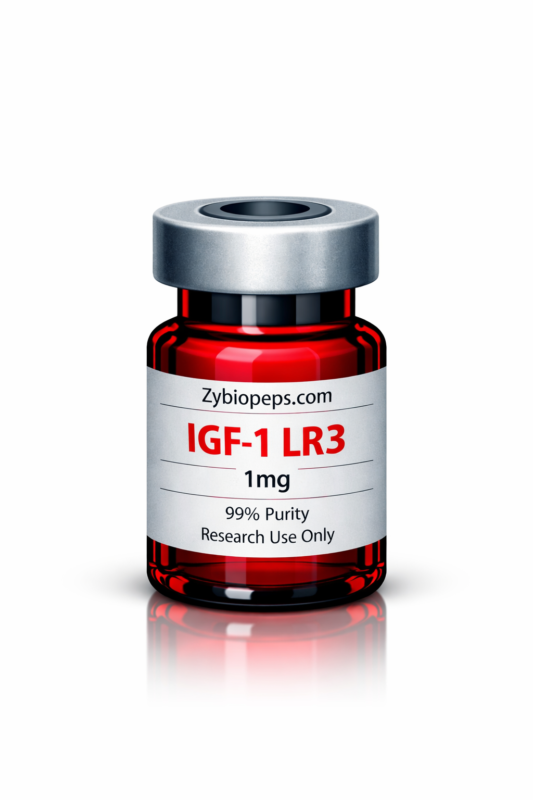
IGF-1 LR3 benefits have become a focal point in advanced peptide research, and the science behind why is rooted in a simple but powerful modification. Native IGF-1 — insulin-like growth factor 1 — is one of the most important anabolic hormones in the body, but it has a critical limitation: a half-life of just 10 to 15 minutes. The LR3 modification changes everything. By substituting arginine at position 3 and adding a 13-amino acid N-terminal extension, researchers created a variant that stays active in circulation for 20 to 30 hours and binds far less to IGF binding proteins, meaning more of the compound remains free and biologically active. That single change transforms native IGF-1 from a fleeting signal into a sustained anabolic driver.
At Zybiopeps, this growth factor analog is available in 0.1mg and 1mg concentrations for research purposes. We ship same day from our USA warehouse via USPS and FedEx, and every batch is independently HPLC tested to 99%+ purity by a USA-based third-party laboratory. A certificate of analysis is available for every order. We ship to the USA, UK, Australia, Germany, Canada, the Philippines, and worldwide.
Here’s what the research literature shows about this compound and why it occupies a unique position in the growth factor peptide space.
What Is IGF-1 LR3?
IGF-1 LR3 — formally known as Long Arg3 Insulin-like Growth Factor-1 — is a recombinant analog of human IGF-1 engineered for enhanced potency and duration. The natural form of IGF-1 is produced primarily in the liver in response to growth hormone signaling, and it mediates many of GH’s downstream anabolic effects on muscle, bone, and connective tissue. The LR3 variant bypasses the hypothalamic-pituitary-GH axis entirely and delivers IGF-1 receptor activation directly, which gives it a distinct research profile compared to GH secretagogues like ipamorelin or CJC-1295.
What’s interesting is that this modified peptide acts directly on the mTOR pathway — the master regulator of muscle protein synthesis — without needing to wait for the GH-IGF-1 signaling cascade to unfold. This direct mechanism, combined with its extended half-life, makes it one of the most potent research tools available for studying anabolic signaling, satellite cell activation, and tissue repair at the cellular level.
Muscle Protein Synthesis Research
The primary research interest in this compound centers on its effects on muscle protein synthesis and satellite cell proliferation. IGF-1 receptors are expressed throughout skeletal muscle, and when activated, they trigger a downstream signaling cascade through PI3K/Akt/mTOR that directly stimulates protein synthesis and inhibits protein breakdown. Research in both cell culture and animal models has documented significant hypertrophic responses to Long R3 IGF-1 administration.
Satellite cells — the muscle stem cells responsible for repair and growth after exercise or injury — are particularly responsive to IGF-1 signaling. Studies have shown that the LR3 variant activates satellite cell proliferation and differentiation, accelerating the muscle repair process. For researchers studying skeletal muscle biology, hypertrophy mechanisms, or recovery from muscle injury, this growth factor analog provides a direct anabolic stimulus that operates independently of the GH axis.
Body Recomposition Research
IGF-1 plays a dual role in body composition — stimulating muscle anabolism while simultaneously promoting fat oxidation through its effects on insulin signaling and lipid metabolism. Research has explored whether the extended activity window of the LR3 variant translates into measurable body recomposition effects in animal models. Several studies have documented reductions in fat mass alongside increases in lean tissue in treated subjects, though the mechanisms are complex and involve multiple metabolic pathways.
Here’s the thing — this compound sits in a different research category from GLP-1 peptides like semaglutide or tirzepatide, which target fat loss primarily through appetite suppression and metabolic rate. The LR3 variant approaches body composition from the anabolic side, potentially supporting lean mass preservation or growth while metabolic changes occur. Researchers designing body recomposition protocols often examine both pathways. Our Semaglutide and Tirzepatide product pages have full specifications for researchers studying the GLP-1 side of the equation.
Tissue Repair and Recovery Research
Beyond muscle, IGF-1 receptors are expressed in bone, cartilage, tendon, and connective tissue throughout the body. Research has investigated this analog’s potential applications in tissue repair contexts, with animal studies documenting accelerated healing of muscle tears, improved collagen synthesis, and enhanced bone mineral density responses. The extended half-life makes it particularly interesting for recovery research because sustained IGF-1 receptor activation over 20 to 30 hours may drive more complete tissue repair responses than brief native IGF-1 pulses.
Researchers studying recovery peptides often compare the LR3 variant with BPC-157 and TB-500, which operate through different mechanisms. BPC-157 promotes angiogenesis and growth factor upregulation at injury sites, while TB-500 works through thymosin beta-4 pathways affecting actin dynamics and cell migration. Long R3 IGF-1 adds a systemic anabolic growth signal on top of these localized repair mechanisms. Our BPC-157 and TB-500 pages have full research specifications for comparative protocol design.
IGF-1 LR3 vs Native IGF-1
The key differences between this modified analog and native IGF-1 come down to three factors: half-life, binding protein affinity, and potency. Native IGF-1 circulates for 10 to 15 minutes before being cleared or sequestered by IGF binding proteins. The LR3 variant circulates for 20 to 30 hours. Native IGF-1 binds strongly to IGFBPs, which limits the amount of free, active compound available to tissues. The LR3 modification dramatically reduces IGFBP binding, meaning a far higher proportion of the administered compound reaches IGF-1 receptors in muscle, bone, and other tissues. The result is a compound roughly 2 to 3 times more potent than native IGF-1 on a molar basis.
This potency difference is precisely why Long R3 IGF-1 is classified as an advanced research compound. Its direct mTOR activation and lack of physiological feedback regulation — unlike GH secretagogues which work within the body’s natural pulsatile framework — means researchers must design protocols carefully to study its effects accurately.
IGF-1 LR3 and Growth Hormone Peptide Stacks
Researchers studying the GH/IGF-1 axis frequently examine how this compound interacts with upstream GH secretagogues. Peptides like ipamorelin, CJC-1295, and GHRP-2 stimulate the pituitary to release growth hormone, which then signals the liver to produce endogenous IGF-1. The LR3 variant bypasses this entire cascade and activates IGF-1 receptors directly. In research contexts, this makes it complementary to rather than redundant with GH secretagogues — the two approaches activate the same downstream pathways through different entry points.
For researchers building comprehensive GH axis protocols, our Ipamorelin, CJC-1295, and GHRP-2 pages have full product details. Researchers ordering multiple compounds can access our wholesale program for bulk research pricing with same-day USA warehouse shipping on every order.
Research Considerations
Long R3 IGF-1 is considered an advanced research compound due to its potency and direct mTOR activation. One important consideration in research protocol design is its effect on insulin signaling — IGF-1 receptors share structural similarity with insulin receptors, and high-dose administration can produce hypoglycemic effects in animal models by activating insulin receptor pathways. Researchers monitoring metabolic parameters in studies using this compound should account for glucose dynamics as a relevant endpoint.
The compound is typically reconstituted with bacteriostatic water for research applications and stored at low temperatures to maintain stability. A key peer-reviewed study on IGF-1 and muscle satellite cell activation is available on PubMed for researchers reviewing the foundational literature on IGF-1 receptor signaling and skeletal muscle biology.
Frequently Asked Questions About IGF-1 LR3
What makes IGF-1 LR3 different from regular IGF-1?
The LR3 modification extends the half-life from 10-15 minutes to 20-30 hours and dramatically reduces binding to IGF binding proteins. This makes the modified variant 2-3 times more potent than native IGF-1 and far more suitable for research applications requiring sustained IGF-1 receptor activation.
How does this compound differ from GH secretagogues like ipamorelin?
GH secretagogues stimulate the pituitary to release growth hormone, which then triggers endogenous IGF-1 production in the liver. The LR3 variant bypasses this entire cascade and activates IGF-1 receptors directly. The two approaches are complementary rather than interchangeable in research contexts.
What concentrations does Zybiopeps stock?
We stock IGF-1 LR3 in 0.1mg and 1mg concentrations. Every batch is independently HPLC tested to 99%+ purity by a USA-based third-party laboratory. A certificate of analysis is available for every batch upon request.
Where does Zybiopeps ship?
Same-day shipping from our USA warehouse via USPS and FedEx to the USA, UK, Australia, Germany, Canada, the Philippines, and worldwide. Minimum order is $100.
What peptides are commonly studied alongside this compound?
Researchers frequently pair it with GH secretagogues like ipamorelin and CJC-1295, and with tissue repair peptides like BPC-157 and TB-500. The combination of direct IGF-1 receptor activation with upstream GH stimulation and localized repair mechanisms covers multiple anabolic and regenerative pathways simultaneously.
Is IGF-1 LR3 the same as HGH?
No. HGH is growth hormone itself, which acts on GH receptors and stimulates downstream IGF-1 production. The LR3 variant is a modified form of IGF-1, the downstream mediator of GH’s anabolic effects. They operate at different points in the same signaling cascade and have distinct research profiles.
Disclaimer: IGF-1 LR3 is sold by Zybiopeps strictly for research purposes. It is not intended for human consumption, is not FDA approved, and should not be used as a medical treatment. All information on this page is provided for educational and research purposes only. Researchers should comply with all applicable laws and institutional guidelines when handling research peptides.
