
Research and Education
pamorelin vs CJC-1295 — Research Comparison Guide
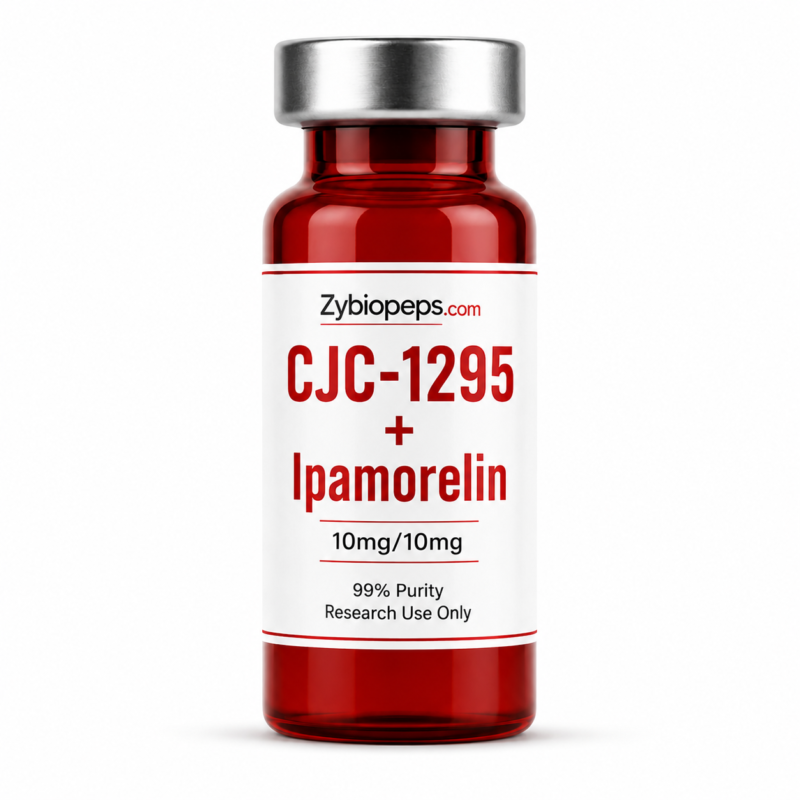
Ipamorelin vs CJC-1295 is one of the most common comparisons researchers encounter when studying growth hormone secretagogues — and for good reason. Both peptides work within the same general pathway, both have solid preclinical literature behind them, and both are frequently studied together in combination protocols. But they work differently, and understanding those differences matters for designing a sound research protocol.
Here’s the short version: Ipamorelin is a selective growth hormone secretagogue that stimulates GH release in a pulsatile, targeted way. CJC-1295 is a GHRH analogue that extends the half-life of growth hormone releasing hormone, sustaining elevated GH levels over a longer window. One is precise and fast-acting. The other is sustained and cumulative. That’s why researchers often study them together rather than choosing one over the other.
Our research team at Zybiopeps has reviewed the literature on both compounds extensively — they’re two of our most requested products and among the most studied growth hormone peptides in preclinical research today.
How Ipamorelin Works
Ipamorelin belongs to a class of compounds known as growth hormone releasing peptides (GHRPs). It stimulates the pituitary gland to release growth hormone in a selective, pulse-like manner. What makes it particularly interesting to researchers is its selectivity — it produces GH release without significantly elevating cortisol or prolactin levels, which is a common concern with older GHRPs like GHRP-6.
Preclinical studies have shown Ipamorelin to be well-tolerated in animal models with a clean stimulation profile. Its short half-life — estimated at around two hours — means GH pulses are time-specific, making it useful for research protocols that require precise timing control. For studies examining the timing and amplitude of GH secretion, Ipamorelin gives researchers a high degree of experimental control.
You can find our research-grade Ipamorelin in our full product catalogue, third-party HPLC tested to 99%+ purity with COA available on every batch.
How CJC-1295 Works
CJC-1295 is a synthetic analogue of growth hormone releasing hormone (GHRH). Unlike Ipamorelin, which triggers a GH pulse, CJC-1295 works by amplifying and extending the body’s own GHRH signal. The result is a sustained elevation of GH and IGF-1 levels over a much longer window — with some formulations showing half-lives extending to several days.
What’s interesting is that CJC-1295 doesn’t just cause a single GH spike — it raises the baseline from which GH pulses occur. Research in animal models has shown consistent increases in GH and IGF-1 levels over extended periods, making it a useful tool for studies examining longer-term growth hormone dynamics and downstream anabolic effects.
Our research-grade CJC-1295 is available with the same purity standards — HPLC tested, COA included, sealed laboratory-grade vials dispatched same day from our USA warehouse.
Ipamorelin vs CJC-1295 — Key Differences
The most fundamental difference between these two compounds is mechanism. Ipamorelin is a GHRP — it acts on ghrelin receptors to trigger GH release. CJC-1295 is a GHRH analogue — it acts on GHRH receptors to amplify and sustain GH output. Different receptors, different signalling pathways, complementary effects.
Half-life is another key distinction. Ipamorelin has a short half-life of roughly two hours, producing defined, measurable GH pulses. CJC-1295 without DAC has a half-life of around 30 minutes, while CJC-1295 with DAC extends to several days due to albumin binding. This makes the two compounds useful for different experimental designs — Ipamorelin for acute pulse studies, CJC-1295 for sustained elevation models.
Selectivity is where Ipamorelin stands out. It’s one of the cleanest GHRPs in terms of side effect profile in animal models — minimal cortisol, minimal prolactin elevation. CJC-1295 doesn’t carry the same ACTH/cortisol concerns by nature of its mechanism, but the sustained GH elevation it produces creates a different set of variables to account for in long-term protocols.
CJC-1295 vs Ipamorelin — Why Researchers Often Study Both Together
The reason you’ll frequently see CJC-1295 and Ipamorelin studied in combination comes down to complementary mechanisms. CJC-1295 raises the GH baseline — it amplifies GHRH signalling and creates a sustained elevated environment. Ipamorelin then triggers defined GH pulses on top of that elevated baseline. The combined effect in preclinical models has shown greater GH output than either compound alone.
Think of it this way: CJC-1295 loads the system, Ipamorelin fires it. That’s why combination protocols are so common in the growth hormone research literature, and why both compounds consistently appear together in ordering data from research teams.
A 2006 study published on PubMed demonstrated that CJC-1295 produced sustained dose-dependent increases in GH and IGF-1 levels in human subjects over multiple days following a single administration — foundational data that continues to inform combination research designs today.
CJC-1295 Ipamorelin vs Sermorelin
Researchers sometimes ask how this combination compares to Sermorelin, another GHRH analogue with its own research history. Sermorelin has a shorter half-life than CJC-1295 and a more modest GH stimulation profile. In terms of published literature, CJC-1295 has shown stronger and more sustained GH elevation in comparative models. Sermorelin remains relevant for certain research designs, particularly those requiring a shorter-acting GHRH analogue, but CJC-1295 generally produces more robust results in combination protocols.
Ordering Ipamorelin and CJC-1295 for Research
At Zybiopeps, Ipamorelin and CJC-1295 are two of our most requested compounds — consistently. Researchers ordering from Zybiopeps can be confident that every vial is third-party HPLC tested to 99%+ purity, sealed in laboratory-grade vials inspected before dispatch, and shipped same day from our USA warehouse via USPS and FedEx.
The minimum order is just $100, making it accessible for research teams at any scale. For labs placing regular or bulk orders, our wholesale program is worth exploring at zybiopeps.com/wholesale-peptides/. We ship to the USA, UK, Australia, Germany, Philippines, Canada, and worldwide. COA is available for every batch.
Frequently Asked Questions — Ipamorelin vs CJC-1295
What is the main difference between Ipamorelin and CJC-1295?
Ipamorelin is a GHRP that triggers selective GH pulses via ghrelin receptors. CJC-1295 is a GHRH analogue that extends and amplifies GHRH signalling for sustained GH elevation. Different mechanisms, complementary effects.
Why do researchers study Ipamorelin and CJC-1295 together?
The combination produces greater GH output than either compound alone in preclinical models. CJC-1295 elevates the GH baseline while Ipamorelin triggers defined pulses on top of that elevated environment — a complementary dual-mechanism approach.
How does CJC-1295 compare to Sermorelin?
CJC-1295 generally produces stronger and more sustained GH elevation than Sermorelin in comparative studies. Sermorelin has a shorter half-life and more modest stimulation profile, making it useful for specific research designs that require shorter-acting GHRH analogues.
What is the half-life of Ipamorelin vs CJC-1295?
Ipamorelin has an estimated half-life of around two hours. CJC-1295 without DAC is approximately 30 minutes, while CJC-1295 with DAC extends to several days due to albumin binding. This difference makes them suitable for different experimental timing designs.
Are Ipamorelin and CJC-1295 available for research ordering at Zybiopeps?
Yes. Both are available in our catalogue, third-party HPLC tested to 99%+ purity with COA on every batch. Minimum order $100, same-day shipping from our USA warehouse via USPS and FedEx.
Disclaimer: All products sold by Zybiopeps are intended for research purposes only. They are not approved for human consumption, medical use, or veterinary use. Information provided in this article is for educational purposes and does not constitute medical advice. Researchers are responsible for complying with all applicable local laws and regulations regarding the purchase and use of research compounds.
